
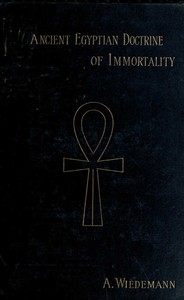
The ancient Egyptian doctrine of the immortality of the soul by Alfred Wiedemann
Published in 1895, Alfred Wiedemann's book is a deep exploration of Egyptian religious thought, specifically focusing on their concept of the soul. Wiedemann was a German Egyptologist, and he wrote this to clarify a topic he felt was often misunderstood. The book isn't a narrative with characters, but the "story" is the evolution of a belief system.
The Story
Wiedemann guides us through ancient Egyptian texts, tomb inscriptions, and religious papyri to piece together their doctrine. He shows that their view wasn't simple. They believed the human being was made of several spiritual parts. The Ka was your life force or double, present from birth. The Ba was your personality, often shown as a bird with a human head, which could travel after death. The Akh was the transformed, effective spirit of the deceased in the afterlife. The book explains the rituals, like the Opening of the Mouth ceremony, meant to reanimate these parts. The central plot is humanity's struggle against oblivion, and the intricate religious system the Egyptians built to ensure their soul's survival for eternity.
Why You Should Read It
This book turns the static images of gods and sarcophagi into a dynamic, living philosophy. What struck me was how logical and detailed their system was. It wasn't just blind faith; it was a carefully constructed blueprint for immortality. Wiedemann connects their beliefs to their art, their social structure, and their daily lives in a way that makes ancient people feel relatable. You start to see the tomb paintings not as strange art, but as instruction manuals and hopeful maps for a journey we all wonder about. It gives profound context to the artifacts we see in museums.
Final Verdict
This is a classic, so the language is a bit formal, but the ideas are incredibly accessible. It's perfect for history buffs, especially anyone fascinated by ancient Egypt beyond the pharaohs and pyramids. It's also great for readers interested in comparative religion or the history of ideas about death and the soul. If you enjoy authors like Erik Hornung or Jan Assmann, Wiedemann is a foundational voice you should meet. Just be ready to think—this isn't a light novel, but the intellectual journey is absolutely rewarding.
Barbara Nguyen
7 months agoVery interesting perspective.
Paul Johnson
9 months agoTo be perfectly clear, the atmosphere created is totally immersive. I would gladly recommend this title.
Charles Wright
9 months agoMy professor recommended this, and I see why.

Kenneth Wright
1 year agoA bit long but worth it.