
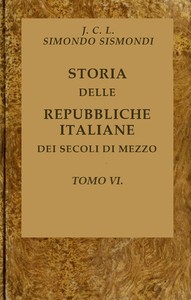
Storia delle repubbliche italiane dei secoli di mezzo, v. 06 (of 16) by Sismondi
Let's be clear: this is a history book, not a novel. There's no single protagonist. Instead, the 'characters' are the republics themselves—Venice, Florence, Genoa, Milan, and a host of smaller players. The Story in this sixth volume picks up as these cities are navigating a world of intense pressure. They're not just fighting external enemies like foreign empires or the Papacy; they're often fighting each other in shifting alliances that change by the season. Sismondi tracks the political maneuvers, the trade wars, and the internal revolutions within city walls. We see how the original republican ideals, built on merchant guilds and citizen councils, get strained by the rise of ultra-wealthy families who want to turn a republic into their personal dynasty. It's a detailed account of constitutions being tested, laws being bent, and the constant, fragile balance between liberty and order.
Why You Should Read It
I got hooked because Sismondi writes with a sense of urgency. He was a liberal writing in the early 1800s, watching new revolutions sweep Europe, and you can feel him asking, 'What lessons are here for us?' He makes you care about political structures. The tension between civic virtue and raw ambition, the way economic power corrupts political systems, and how fear of an external threat can make people give up their freedoms—it all feels uncomfortably familiar. You start seeing patterns that repeat far beyond medieval Italy. It’s not light reading, but it’s surprisingly gripping when you follow the human drama behind the political events.
Final Verdict
This is absolutely for history lovers with some patience, but don't let that scare you off. It's perfect for anyone fascinated by the rise and fall of societies, political strategy, or the origins of the Renaissance world. If you enjoy books that explore 'how civilizations work' like Jared Diamond's or Will Durant's works, but prefer primary-source depth, Sismondi is your guy. This volume is a deep dive into a critical pivot point, best enjoyed if you have a basic map of medieval Italy handy. It rewards the curious reader with a profound look at the cycles of history.
Jackson Young
4 months agoAfter hearing about this author multiple times, the narrative structure is incredibly compelling. Thanks for sharing this review.
Kevin Thompson
1 year agoThis book was worth my time since the pacing is just right, keeping you engaged. A valuable addition to my collection.
Donald Perez
1 year agoThe layout is very easy on the eyes.






Linda Williams
1 year agoAs someone who reads a lot, the arguments are well-supported by credible references. Don't hesitate to start reading.