
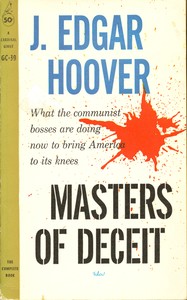
Masters of deceit : The story of Communism in America and how to fight it
Let's talk about J. Edgar Hoover's 'Masters of Deceit.' To be clear, this isn't a novel or a standard history. It's a primary source, a document straight from the heart of the Cold War.
The Story
Hoover, the longtime director of the FBI, uses this book to explain what he sees as the grave danger of communism in the United States. He breaks down the ideology, describes how he believes communist groups operate secretly to recruit members and undermine American institutions, and outlines the methods the FBI used to counter them. The "plot" is the ongoing, hidden war between American democracy and a subversive force. Hoover paints a picture of constant vigilance, where everyday citizens could be potential targets or, worse, unwitting helpers. The book serves as both a warning to the public and a justification for the FBI's extensive surveillance and investigative tactics during that period.
Why You Should Read It
This book is a time capsule. Reading it today is a stark reminder of how potent fear can be in shaping politics and society. Hoover's writing is direct and urgent, which makes it incredibly engaging from a historical perspective. You're not getting a balanced, modern analysis; you're getting Hoover's voice, his convictions, and his fears laid bare. It helps explain the mindset that led to McCarthyism and decades of domestic surveillance. Whether you find his arguments compelling or deeply flawed, understanding this viewpoint is key to understanding a huge chunk of American history. It's also a fascinating look at how a powerful government official communicated directly with the public to build support for his agency's mission.
Final Verdict
This book is perfect for history buffs, political science readers, or anyone interested in the roots of modern American security and conspiracy culture. It's not for someone looking for a neutral account—this is Hoover's side of the story, full stop. Approach it as a historical artifact, not a definitive truth. If you can read it with that critical eye, it's a profoundly insightful and sometimes unsettling window into a past that still echoes loudly today.
Margaret Lee
2 months agoFinally found time to read this!
Sarah Flores
5 months agoNot bad at all.
Robert Walker
3 months agoHaving read this twice, the clarity of the writing makes this accessible. I couldn't put it down.
Kimberly Lee
7 months agoBeautifully written.



Mark Clark
1 year agoAfter finishing this book, it provides a comprehensive overview perfect for everyone. Worth every second.