
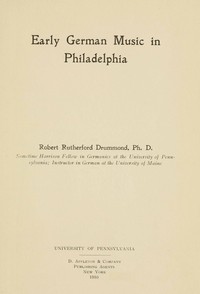
Early German music in Philadelphia by Robert Rutherford Drummond
Forget everything you think you know about music in early America being just fife-and-drum bands or Puritan hymns. Robert Drummond's book introduces us to a vibrant, organized, and surprisingly sophisticated musical world that was thriving in Philadelphia decades before the Declaration of Independence was signed.
The Story
Drummond traces the journey of German-speaking immigrants—Moravians, Lutherans, and others—who settled in Pennsylvania. They didn't just bring their tools and Bibles; they brought their music books, their passion for choral singing, and their skill with instruments. The book shows how these communities established singing schools, carefully copied complex musical scores by hand, and formed the nuclei of what would become professional musical societies. It follows the paper trail of their lives: church records, personal diaries, and the few surviving sheets of music they prized. The narrative isn't about a single event, but about the steady, persistent effort to maintain a cultural identity through song in a new and sometimes isolating land.
Why You Should Read It
What struck me most was the sheer normalcy of it. These weren't famous composers, but teachers, farmers, and pastors for whom music was a daily part of life, like baking bread. Drummond makes you feel the weight of a carefully preserved hymnbook carried across an ocean. He shows how music was a social glue, a comfort, and an act of defiance against forgetting who they were. It adds a rich, emotional layer to the dry dates of colonial history. You start to hear the 18th century differently—not as a silent prelude to revolution, but as a place already filled with harmony and disagreement.
Final Verdict
This is a niche book, but a rewarding one. It's perfect for history buffs who are tired of military and political narratives and want to understand the cultural bedrock of America. Music lovers will appreciate seeing how classical European traditions took early root here. It's not a light read—it's a detailed, academic work—but Drummond's passion for his subject is clear on every page. If you've ever walked Philadelphia's old streets and wondered what it sounded like 300 years ago, this book provides the score.
Susan Smith
1 year agoComprehensive and well-researched.
Charles Clark
1 year agoWithout a doubt, the narrative structure is incredibly compelling. A valuable addition to my collection.
Sandra Lee
1 year agoThis is one of those stories where it creates a vivid world that you simply do not want to leave. Truly inspiring.
George Scott
7 months agoWow.






David Robinson
1 year agoFast paced, good book.