
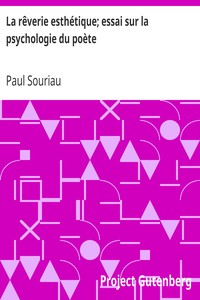
La rêverie esthétique; essai sur la psychologie du poète by Paul Souriau
Published in 1893, Paul Souriau's La rêverie esthétique; essai sur la psychologie du poète (The Aesthetic Reverie; Essay on the Psychology of the Poet) is not a story with characters and a plot. Instead, it's an exploration of a single, big idea: how poetry is born in the mind.
The Story
There's no traditional narrative here. Think of it as Souriau taking you on a guided tour of the creative process. He starts by challenging the common belief that artists are just passive vessels for divine inspiration. Instead, he builds a case for creation being an active, psychological state he calls 'aesthetic reverie.' This isn't idle zoning out. It's a directed, almost playful form of mental wandering where the poet's senses, emotions, and memories mix together. Souriau breaks down how physical sensations, like rhythm or color, transform into abstract ideas and emotions, which then seek their perfect expression in words. The 'story' is the journey of an idea, from a fuzzy feeling to a finished poem.
Why You Should Read It
What grabbed me was how relatable Souriau makes this high-concept stuff. When he describes the poet's mind gathering impressions like 'a soft and sticky paste,' it clicks. You recognize that state from your own creative hobbies, or even from getting lost in a daydream. He connects art to basic human psychology—our love of rhythm, our tendency to personify objects, our need to find patterns. It demystifies the poet without removing the wonder. You finish the book feeling like you understand the machinery of creativity better, which somehow makes the final product—the poem—even more impressive.
Final Verdict
This is a perfect read for curious minds who love art but don't need overly academic jargon. It's for poets and writers looking for a historical perspective on their craft, and for any reader who has ever finished a beautiful poem and thought, 'How did they do that?' Be prepared for a 19th-century writing style (it was written in French, so your experience depends on the translation), but the ideas inside are timeless and surprisingly fresh. It's a short, thoughtful book that will change how you think about where art comes from.
Joshua Johnson
1 year agoAs someone who reads a lot, the character development leaves a lasting impact. Thanks for sharing this review.
Emily Young
3 months agoHaving read this twice, the character development leaves a lasting impact. Definitely a 5-star read.
Emily Johnson
1 year agoBased on the summary, I decided to read it and it creates a vivid world that you simply do not want to leave. Worth every second.
Kimberly Nguyen
1 year agoIf you enjoy this genre, the storytelling feels authentic and emotionally grounded. I couldn't put it down.


Margaret Torres
1 year agoIf you enjoy this genre, it challenges the reader's perspective in an intellectual way. I couldn't put it down.