
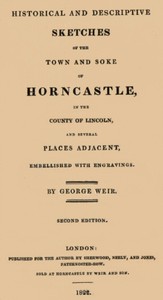
Historical and descriptive sketches of the town and soke of Horncastle [1822]
Let's be clear from the start: this is not a storybook. There's no plot twist or villain. George Weir's 1822 book is exactly what the title says—a collection of sketches about Horncastle, a market town in Lincolnshire, England. Think of it as a guided tour given by a very knowledgeable, slightly fussy local historian from two centuries ago.
The Story
There isn't a traditional narrative. Instead, Weir acts as your guide. He walks you through the town's physical layout, pointing out the important buildings, the streets, and the river. He digs into the past, recounting what he knows (or what records show) about Horncastle's origins, its role in regional markets (especially for horses), and its notable events. He lists the prominent families and landowners, giving you a social map of the place. The 'story' is the story of the town itself, from its distant past right up to the moment Weir put pen to paper. He's capturing a snapshot, fearing that the old ways and old knowledge might be forgotten.
Why You Should Read It
This book's power is in its specificity and its perspective. You're not reading a modern historian's analysis; you're reading the thoughts of someone who lived there, for whom this history was immediate. The charm is in the small details—the mention of a yearly fair, the description of a building's architecture, the notes on local industry. It feels personal. Weir isn't writing for fame; he's writing for his community and for posterity. Reading it, you get a powerful sense of place and a tangible connection to 1822. You see what mattered to people then, how they organized their world, and how they viewed their own history.
Final Verdict
This is a niche read, but a rewarding one. It's perfect for local history enthusiasts, genealogists with ties to Lincolnshire, or anyone who loves primary sources and the raw material of history. If you enjoy wandering through old cemeteries or imagining the layers of life in a single street, you'll find something here. It's not a page-turner, but a slow, thoughtful immersion into a single point on the map, frozen in time by a writer who clearly cared. Approach it like a museum visit, not a movie, and you'll be fascinated.
James Ramirez
1 year agoWithout a doubt, the flow of the text seems very fluid. Thanks for sharing this review.
Christopher Davis
1 year agoA must-have for anyone studying this subject.
Anthony Ramirez
9 months agoText is crisp, making it easy to focus.
Patricia Davis
4 months agoCompatible with my e-reader, thanks.






Nancy Jones
2 years agoThis is one of those stories where it manages to explain difficult concepts in plain English. Don't hesitate to start reading.