
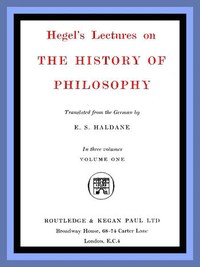
Hegel's Lectures on the History of Philosophy: Volume 1 (of 3) by Hegel
Okay, so calling this a "story" feels weird for a philosophy book, but stick with me. Hegel doesn't just list philosophers and their theories. He arranges them like chapters in a novel where the main character is Reason itself. The book starts at the very beginning of Western thought in ancient Greece. Hegel walks us through the early natural philosophers who asked, "What is everything made of?" He then follows the thread through Socrates, Plato, and Aristotle, showing how each one responded to and built upon the questions left by the last.
Why You Should Read It
Here’s the cool part: Hegel isn't a neutral tour guide. He has a very specific point to make. He believes that human understanding doesn't jump around randomly. Instead, it develops, like a plant growing from a seed. Each philosophical system, even the ones that seem totally wrong or contradictory, was a necessary step. They were all part of a process he calls the "dialectic"—where an idea (thesis) meets its opposite (antithesis), and from that conflict, a new, better idea (synthesis) emerges. Reading this, you get a double feature: you learn about the ancient thinkers, but you're also getting a masterclass in how Hegel himself thinks. It’s philosophy and a biography of a philosophical mind at the same time.
Final Verdict
This isn't a casual beach read. It's for the curious reader who has always wondered how we got from mythical explanations of the world to complex systems of logic and ethics. It's perfect for anyone who loves big ideas and seeing connections between things that seem separate. If you've ever enjoyed a podcast or book about the history of science or thought, and you're ready to go a step deeper into the "why" behind our intellectual journey, this is your book. Just take it slow—a few pages at a time is plenty. Think of it as a workout for your brain, but one that leaves you feeling smarter, not sore.
Elizabeth Williams
1 year agoWithout a doubt, the storytelling feels authentic and emotionally grounded. I couldn't put it down.
Andrew Sanchez
1 year agoNot bad at all.
Nancy Taylor
1 year agoGreat read!
John Gonzalez
1 year agoUsed this for my thesis, incredibly useful.


Donald Robinson
1 year agoI have to admit, the arguments are well-supported by credible references. Exceeded all my expectations.